Gravel driveways in Warner Robins and Houston County
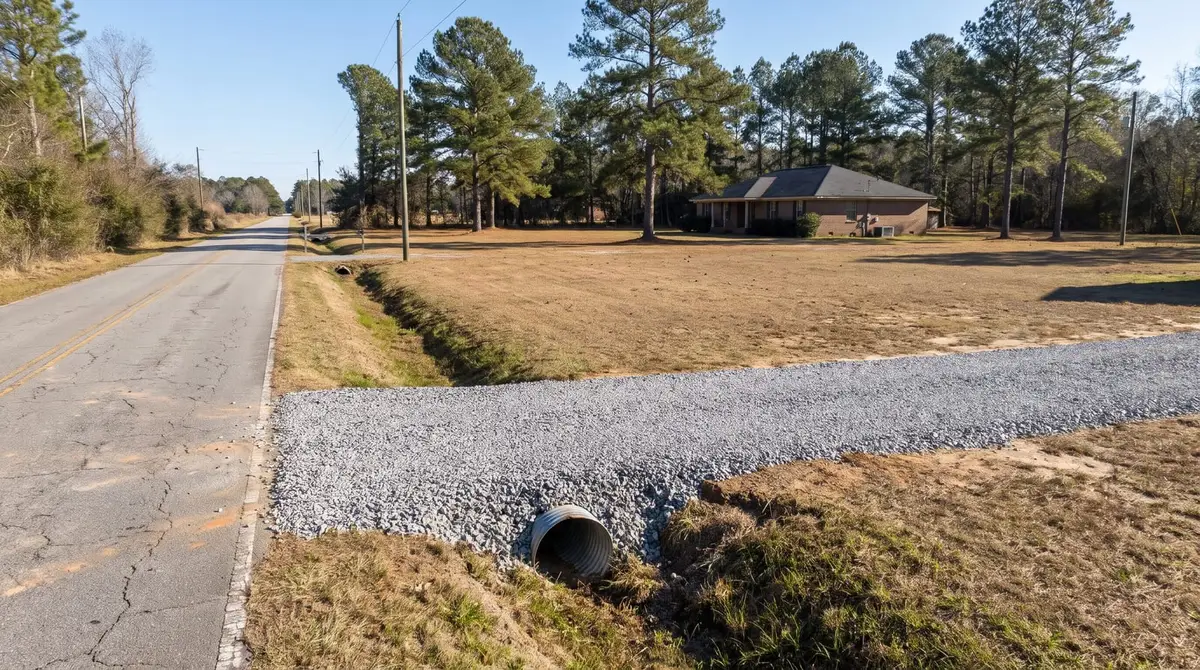
Gravel is the usual choice for long drives on rural Houston County lots, and it costs a fraction of concrete. On flat ground, though, the enemy isn't water rushing downhill; it's water that sits. A drive with no crown and no ditches turns into puddles, then potholes.
Call (478) 339-4999Rather not call? Send the detailsCalls are answered weekdays, 9 to 6. After hours, leave your name, address and what's going on, and you'll get a call back first thing the next business day.
Why do gravel drives get potholes on flat land?
Warner Robins averages about 52 inches of rain a year, going by NOAA's 1991–2020 normals for its local station. Rain that can't run off soaks into the stone and softens the soil underneath. Every car that passes pushes a little stone down into the mud, and a puddle becomes a pothole. Sandy soil holds a load well when it's dry and gives way when it's wet.
The fix is to build the drive a little higher than the ground beside it, crown it so water sheds to both edges, and give that water a ditch to leave by.
How should a gravel driveway be built?
- Strip it: Grass, roots and soft topsoil come out down to firm ground.
- Raise and pack the subgrade: On flat lots, the bed is often built up with fill so the finished drive sits above the yard, then compacted.
- Lay fabric: Filter fabric over the subgrade keeps soil from pumping up into the stone.
- Base, then top: Crushed stone base goes down and is compacted in lifts; a thinner layer of top stone finishes it.
- Crown and edges: A slight hump down the middle and shallow ditches or swales along the sides carry rain away.
What does Houston County require where a drive meets the road?
On a county road, you need a driveway permit before any work in the right-of-way, and the county decides at a site visit whether a culvert is needed and what size. The county also asks for the drive to be paved, or covered with at least 2 inches of gravel, out to the right-of-way line.
See the driveway culvert page for the pipe rules. Inside Warner Robins, Perry or Centerville, check with the city for driveways on city streets.
Can an old gravel drive be saved?
Usually. A grader or skid steer can cut out the potholes, rebuild the crown and pull stone back from the edges. Low sections can be raised with new base, and a ditch or culvert can give standing water a way out.
If the whole drive is soft every winter, the base has failed. Rebuilding it costs less over a few years than adding top stone every spring.
How much does a gravel driveway cost in Houston County?
HomeGuide's national 2026 figures put a new gravel driveway at about $4 to $10 a square foot, or roughly $4,000 to $10,000 for a drive 100 feet long and 10 feet wide. Fill to raise the bed, fabric, a culvert at the road and the base thickness move the price most.
Ask each crew for the compacted base depth and the stone sizes in writing, not just tons of gravel.
Common questions
What stone should I use?
A crushed, angular base stone that locks together when packed, with a cleaner top stone. Round pea gravel rolls and ruts.
Do I need a culvert at the road?
If the drive crosses the roadside ditch, almost always. On a county road, the county decides at its site visit.
Gravel or concrete?
Gravel costs less to put in and is simple to fix. Concrete costs more but needs little upkeep. Long rural drives are usually gravel.
Sources: Houston County, Access Management and Encroachment Control Manual (2017), Chapter 6: driveways and culverts (source); USDA NRCS, Official soil series description: Faceville (source); NOAA 1991–2020 climate normals, Warner Robins station (source); HomeGuide, Gravel driveway cost (Dec 2025) (source).
Last reviewed November 2, 2026.
Rather not call? Send the details
A local grading pro will call you back.