Yard grading and regrading in Warner Robins and Houston County
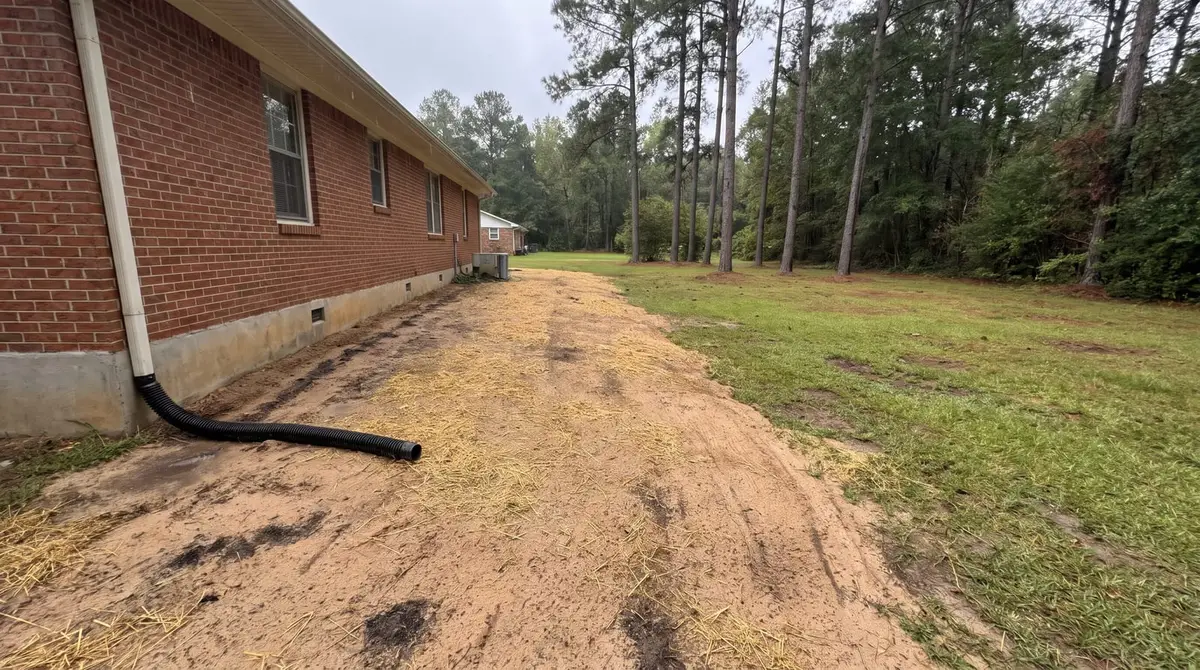
Most yards around Warner Robins are nearly flat, so rain has no reason to leave. It sits by the slab, drowns the grass in the low corner, and soaks the ground under the patio. Regrading builds in just enough fall to send water away from the house, and around a typical home it often runs $1,000 to $3,000.
Call (478) 339-4999Rather not call? Send the detailsCalls are answered weekdays, 9 to 6. After hours, leave your name, address and what's going on, and you'll get a call back first thing the next business day.
Why do flat yards in Houston County hold so much water?
Two things work against you here. First, the land itself: Houston County sits south of the Fall Line in Georgia's Coastal Plain, where the ground is gentle and long stretches have almost no natural slope. Second, the soil: the common upland soils, such as Faceville, start as a sandy loam on top but turn to a sandy clay a foot or so down. Water soaks through the sand quickly, then slows at the clay and spreads sideways.
Some yards also sit on low spots in the land. The Grady soils found in upland depressions in this part of Georgia hold water at or near the surface for months of the year. A yard built over one will stay soggy no matter how often it is seeded.
How much slope does a yard need?
The residential code Georgia follows asks for the ground to drop at least 6 inches in the first 10 feet out from the foundation. On a flat lot, that first 10 feet is often the only real slope the yard will have, so it matters more here than on a hillside.
Past that band, the yard can be close to flat as long as water has a path off the lot: a shallow swale along the property line, a ditch at the street, or a drain. When the lot is too tight for 6 inches of drop, the code allows swales or drains to do the job instead.
What are the signs a yard needs regrading?
- Water against the slab: Puddles along the foundation, wet mulch beds by the walls, or water under the garage door after a storm.
- A low corner that never dries: Grass that dies out, moss, or mosquitoes in the same spot every summer.
- Sunken backfill: On newer homes, the soil pushed back against the foundation settles over the first few years and tips toward the house.
- Sand washing onto the drive: Light sandy topsoil moves easily. Fans of sand on the driveway or patio show where water is running.
What does a regrading crew do?
- Shoot the grades: They measure how high each part of the yard is compared with the slab, and find where the water can leave. Buried lines get marked after a Georgia 811 request.
- Bring in or move soil: On flat lots, regrading usually means adding fill against the house more than cutting high spots, so expect a few loads of dirt.
- Shape and firm it: The new soil is shaped to fall away from the foundation and packed so it doesn't sink back.
- Cover it: Seed and straw or sod go down right away, because sandy topsoil left bare washes off in the first hard rain.
How much does yard grading cost in Warner Robins?
HomeGuide's national 2026 figures put grading around a whole house at $1,000 to $3,000, with most yard grading jobs anywhere from $500 to $5,000, or about $0.40 to $2.00 a square foot. On flat Houston County lots, the number of truckloads of fill is often what moves the price most.
If the yard has no low edge for water to reach, plan for a swale or French drain on top of the grading.
Common questions
Do I need a permit to regrade my yard in Houston County?
Usually not for ordinary yard work. Home gardens and landscaping are exempt from the land-disturbance rules, and permits mostly start at an acre of disturbed ground or work close to a stream. Work in a mapped floodplain is different and needs the county's OK first.
Will more topsoil fix a low spot?
Only if the new soil is shaped so water still has a way out. Filling a low spot level with the rest of a flat yard just moves the puddle.
Why is the water worse after a new house went up next door?
A new pad is often built higher than the older lots around it, and its yard can drain toward yours. Grading along the shared line, or a swale, can carry the water past instead of into your yard.
When is the best time to regrade?
A dry stretch, when the soil can be packed without turning to mush. Spring and early fall give new grass the best start.
Sources: International Residential Code 2024, R401.3 Drainage (adopted in Georgia with amendments) (source); New Georgia Encyclopedia, Fall Line (source); USDA NRCS, Official soil series description: Faceville (source); USDA NRCS, Official soil series description: Grady (source); Houston County, Water Resources Protection Ordinance (2019): erosion permits and the Ocmulgee River corridor (source); Georgia 811, the 811 process (source); HomeGuide, Cost to level or regrade a yard (Jan 2026) (source).
Last reviewed November 2, 2026.
Rather not call? Send the details
A local grading pro will call you back.